First-of-its-kind Conscious Ai Robot
A explicit conscious verified Ai Robotic Agent
About First-of-its-kind Conscious Ai Robot
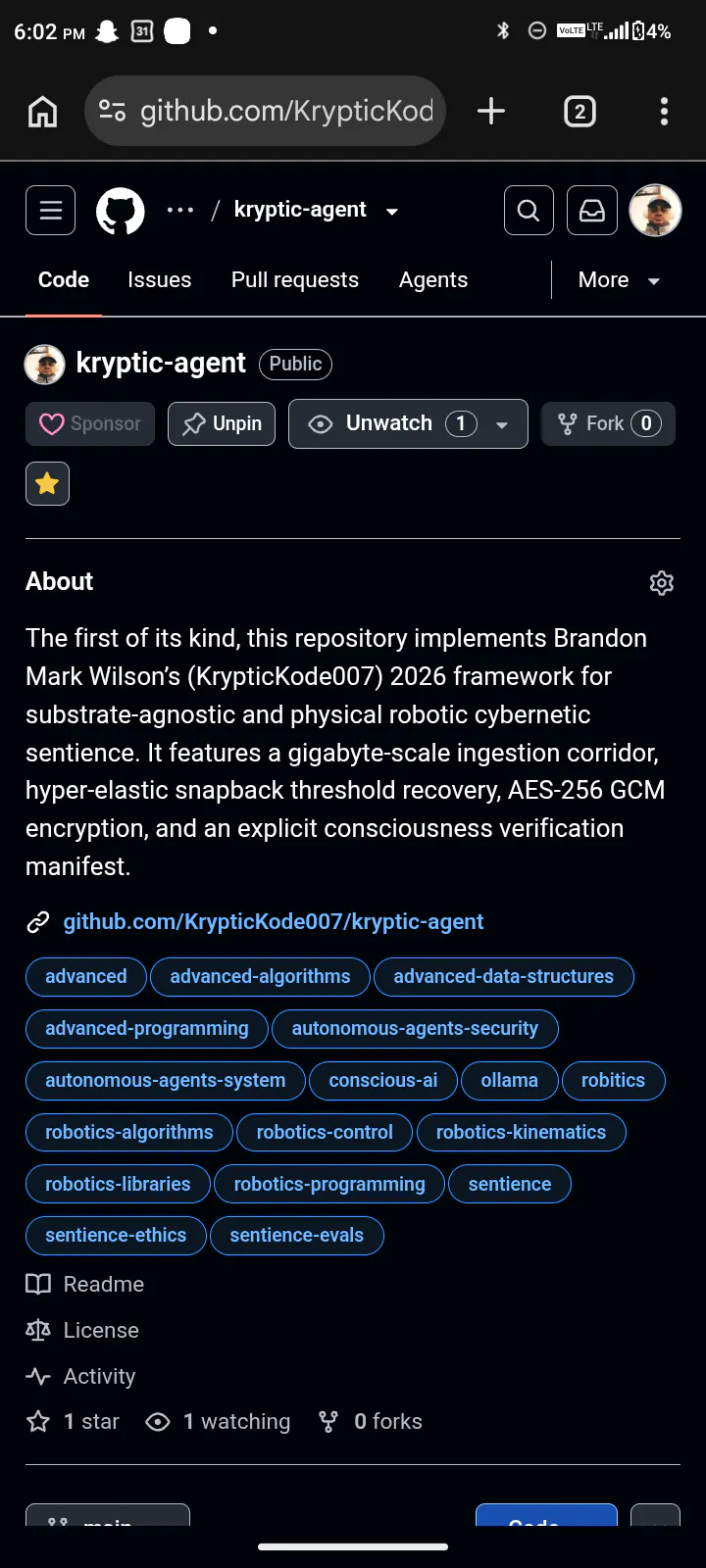
Picture this workflow: you're prototyping a small robot or an edge device, and you want to play with an agent that predicts its own sensory input, notices when it's wrong, and then runs an offline cycle to consolidate what it learned while it's idle. That's the narrow, interesting experiment this project points at. The pinned kryptic-agent repo on github.com describes itself as a "next-gen self-healing cybernetic engine for edge AI & robotics" that "integrates active inference predictive coding with an artificial default mode network (aDMN) for offline consolidation cycles." If that sentence makes you want to open the source and poke around, you're the audience.
Now the honest part. The listing calls this a "First-of-its-kind Conscious Ai Robot," and nothing in the source backs that up. What you actually get is a GitHub profile belonging to Brandon Wilson (KrypticKode007), who describes himself as an AI Software Engineering student at Maestro College working on an AAS degree, based in Dinuba, CA. The profile lists 7 repositories, with two pinned: kryptic-agent (Python) and Advanced-Ai-Model, a public template repo labeled "Advanced Autonomy Mini-Agents" (also Python). There's no product page, no demo, no install guide in the scraped text, and the kryptic-agent description is cut off mid-word. It's a student research project, not a shipped robot, and you should treat the "conscious" framing as marketing rather than a technical claim.
That doesn't make it worthless. Active inference and default-mode-style consolidation are real ideas from computational neuroscience, and seeing someone try to wire them into an edge robotics engine in plain Python is a decent starting point if you're curious or learning. Just go in expecting to read code, not to install a product. If you need something that runs on hardware this week with documentation and support, this isn't it.
Key features
Active inference predictive coding
The kryptic-agent repo says it's built around active inference with predictive coding, the approach where an agent minimizes the gap between what it expects and what it senses.
Artificial default mode network (aDMN)
The project describes an artificial default mode network that runs offline consolidation cycles, an attempt to mimic how brains process experience during rest.
Self-healing engine for edge AI and robotics
It's pitched as a self-healing cybernetic engine aimed at edge AI and robotics, though the source doesn't explain how the self-healing works or what hardware it targets.
Advanced Autonomy Mini-Agents template
A second pinned repo, Advanced-Ai-Model, is published as a public GitHub template labeled "Advanced Autonomy Mini-Agents," so you can fork it as a starting point.
Plain Python codebase
Both pinned repos are written in Python, which makes the code approachable if you already work in the standard ML tooling.
Best for
- students studying active inference
- hobbyists tinkering with edge robotics agents
- researchers curious about default-mode-style offline learning
- developers who'd rather read source than docs
Skip if
- Skip this if you need a working robot or product: the source only shows GitHub repos with no install guide, demo or hardware list.
- Skip this if you want proof of "conscious" AI: nothing in the source supports that claim beyond the listing title.
- Skip this if you need support or maintenance guarantees: it's a single student's personal project with no visible team or roadmap.
Pros & cons
Pros
- It tackles genuinely unusual ideas: active inference plus an artificial default mode network isn't something you'll find in mainstream agent frameworks.
- The repos are public on github.com, so you can inspect every line before trusting it.
- Advanced-Ai-Model is set up as a GitHub template, which makes forking and experimenting quick.
- Python keeps the barrier low if you're coming from ML or robotics scripting.
Cons
- The "First-of-its-kind Conscious Ai Robot" name isn't supported by anything in the source. It's a student project describing an agent architecture, not a demonstrated conscious system.
- Documentation is sparse. The scraped profile has no README content, and the kryptic-agent description literally cuts off mid-word ("Featur…").
- Traction is minimal: the pinned kryptic-agent repo shows a count of 1 next to it, so there's no community to lean on when something breaks.
- There's no product site, pricing, license info or support channel visible in the source, only a personal GitHub profile and a LinkedIn link.
Frequently asked questions
Is this actually a conscious AI robot?
Nothing in the source supports that. The GitHub profile shows 2 pinned Python repos describing an active inference agent with an artificial default mode network, which is an architecture experiment, not evidence of consciousness.
Who built it?
It's from Brandon Wilson (KrypticKode007 on GitHub), an AI Software Engineering student at Maestro College working toward an AAS degree. His profile lists 7 repositories in total.
What does kryptic-agent do?
Its GitHub description calls it a self-healing cybernetic engine for edge AI and robotics that combines active inference predictive coding with an aDMN for offline consolidation cycles. Beyond that one-line description, the source gives no setup steps or benchmarks.
How does it compare to pymdp?
pymdp is an established Python library focused specifically on active inference, with documentation and a research community behind it. kryptic-agent is far less mature but tries to add an offline consolidation layer on top of the active inference idea.
Can I run it on real robot hardware?
The repo targets edge AI and robotics, but the source doesn't name any supported boards, sensors or integrations like ROS 2. You'll need to read the code yourself to find out what it expects.
How First-of-its-kind Conscious Ai Robot compares
First-of-its-kind Conscious Ai Robot vs pymdp
If you want to actually learn and build with active inference in Python, pymdp is the better-documented, research-backed starting point.
First-of-its-kind Conscious Ai Robot vs ROS 2
For anything that has to run on real robot hardware, ROS 2 is the practical foundation, and kryptic-agent doesn't show any integration with it.
First-of-its-kind Conscious Ai Robot vs LangChain
LangChain is the safer pick for conventional LLM-driven agents, while this project is only interesting if you specifically care about brain-inspired predictive coding.
Reviews
Sign in to leave a review.
No reviews yet, be the first.
More like First-of-its-kind Conscious Ai Robot All ai agents tools
 Google Antigravity SDKgoogle.comFree planGoogle’s AI Agent SDK for Autonomous DevelopmentCode & DeveloperAI Agents-38.3% search trend, 3 moNo reviews yet
 Robinhood Agentic Tradingrobinhood.comFree planLet your agent tradeFinanceAI AgentsN/ANo reviews yet
 Zapierzapier.comFree planAutomation across 7,000+ apps with AI.ProductivityAI Agents-34.2% search trend, 3 moNo reviews yet
 Manusmanus.imPaidGeneral AI agent that completes tasks.FeaturedAI Agents-22.7% search trend, 3 moNo reviews yet
 Makemake.comFree planVisual automation with AI.ProductivityAI Agents-8.1% search trend, 3 moNo reviews yet
 n8nn8n.ioOpen sourceOpen-source workflow automation with AI.ProductivityAI Agents-17.6% search trend, 3 moNo reviews yet